
(For the audio version of this blog, please visit: https://brothersinchristcmf.org/wp-content/uploads/2026/04/Mass-Blog-for-the-2nd-Sunday-of-Easter-2026.mp3)
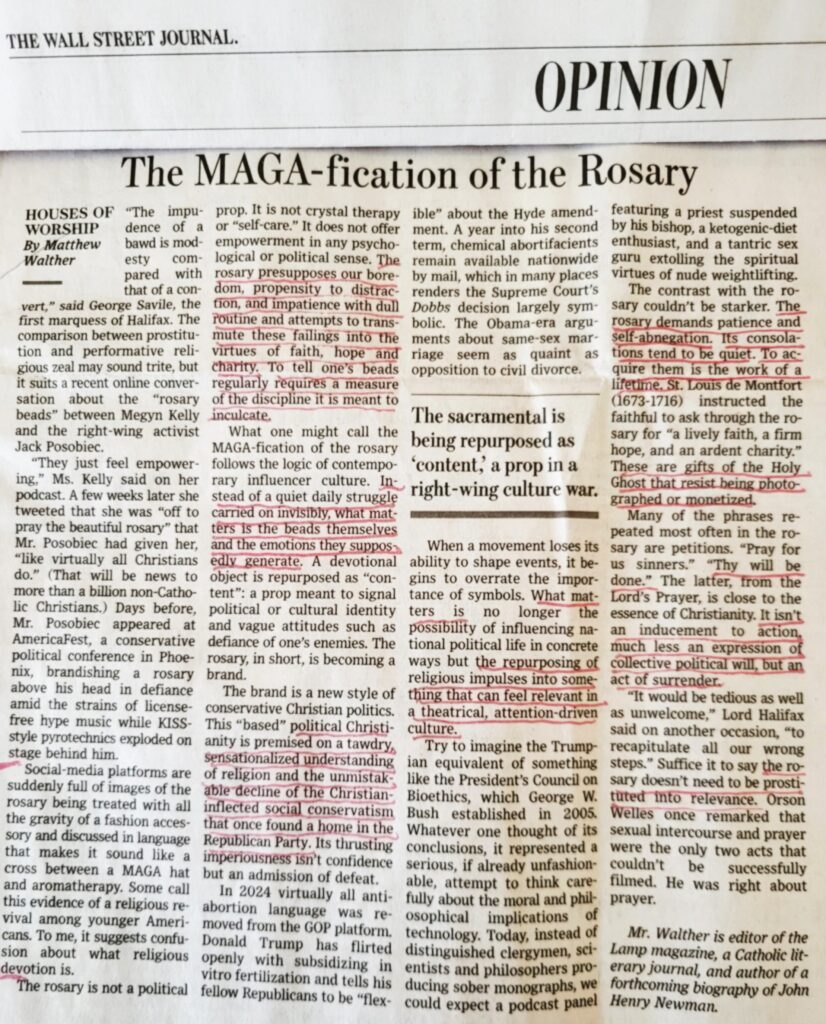
Lately, political extremists have been using sacramentals to push their agendas. Apparently, with the far right it’s rosaries and with the far left it’s the secular sacrament of sports. Recently in a Wall Street Journal Op-Ed, Catholic writer Matthew Walther wrote that the rosary should be a prayer of surrender, not an inducement to political action. On the same page, Columnist Kyle Smith suggested leftists should spend less time shrieking about sports and more time absorbing the soul of sport.
This Sunday’s Mass readings show that the scriptures were written to help move our faith beyond political lip service. The first states that after their Master’s resurrection Christ’s disciples devoted themselves to the teaching of the apostles, to the communal life, to the breaking of bread and to prayers. It also states:
“Many wonders and signs were done through the apostles. All who believed were together and had all things in common; they would sell their property and possessions and divide them among all according to each one’s need.” (Acts 2:42-47)
Even this ancient and holy lifestyle was hijacked by the power- hungry of our modern times. They labeled it Communism. Many leaders of this movement have used it to preserve some high ranking in this world and to control those they’ve forced to believe in THEM. But most of them haven’t had to suffer through their movement’s disciplines as the people under their thumb do. To such leaders, mercy is a foreign language.
What Christians in faith have that Communists in power don’t is the language of truth that is lived, not performed. It safeguards the faithful as they suffer through trials, the way gold is refined by fire. It also teaches them to remember how the apostle Thomas refined his understanding of truth. Through humility.
After his Master’s resurrection, Thomas reserved his belief in a truth that was locked away in his heart until his eyes could find something that would set it free. Finally, upon seeing his risen Master, Thomas exclaimed, “My Lord and my God!” Jesus then refined this nugget of faith with a bit of heat:
“Have you come to believe because you have seen me? Blessed are those who have not seen and have believed.”
This Sunday, John’s gospel addresses the Thomas in all of us:
“Now, Jesus did many other signs in the presence of his disciples that are not written in this book. But these are written that you may come to believe that Jesus is the Christ, the Son of God, and that through this belief you may have life in his name.” (John 20:19-31)
Some op-ed-writing pundits complain that Catholics use the Bible in which these signs are documented as a prop—like the rosary beads they finger to signify belief. But the keys to a rosary well said are the virtues upon which we meditate so we may imitate them.
In his op-ed, Walther noted that St. Louis de Montfort (1673-1716) urged people with rosaries to pray for “a lively faith, a firm hope and an ardent charity.” He opined that “thy will be done” isn’t an inducement to action or an expression of political will, but an act of surrender.
But the rosary, like all prayers, IS an inducement to action. A virtuous Life gives life to our virtues, and the rosary illustrates many more than just faith, hope and charity. Several others are seldom given the lip service they deserve, and they demand life beyond the printed page, whether in a newspaper or our Bible. Humility, patience, fortitude and moral courage in action are God’s way of using us to make this world holier and more whole. By these languages is divine mercy spoken as the prayer of our lives.
–Tom Andel
The contemporary inclination—whether in social media or across the political right and left—is to instrumentalize symbols, practices, and communal passions for ideological ends, reducing them to vehicles of temporal dominance—power expressed through wealth and influence. The Gospel, by contrast, demands conversion. Where ideology seeks control, virtue requires self-mastery. The rosary, rightly prayed, neither withdraws from the world nor inflames it; it orders the soul so that action, when it comes, is governed not by faction but by grace.
George, judging by the gospels, our job is to consider this world a vehicle advancing us toward unity with God’s kingdom, not as a kingdom in itself. Only by God’s grace does this world have purpose. One of NASA’s astronauts, Butch Wilmore, who saw the world from the International Space Station, said it perfectly by quoting John’s gospel: “A man can receive nothing, except it be given him from heaven.” (John 3:27)
Poor Thomas gets a bad rap. I feel his pain! He believed in Jesus but seeing him after the resurrection solidified his belief. Christ’s words to Thomas at this encounter speak clearly to each one of us. Blessed are those who have not seen and yet believe!
This is also illustrated in Mark 9 by the desperate father who wanted his son healed by our Lord, who said all things are possible if you believe, in which the father replied, “I believe Lord, help my unbelief.”
Lord, help my unbelief!
Our name means “Twin,” Thomas, and when it comes to unbelief, all the disciples looked alike before their Master’s death and resurrection. They all scattered when he needed them most. Would they have done that if they really believed? Maybe as they built our church they looked back on their moments of shame to help them empathize with people struggling with their own unbelief.
Thanks a bundle Thomas!
Thanks for being part of our forum, Chris!