
(For the audio version of this blog, please visit: https://brothersinchristcmf.org/wp-content/uploads/2025/09/Mass-Blog-for-the-26th-Sunday-in-Ordinary-Time-2025.mp3)
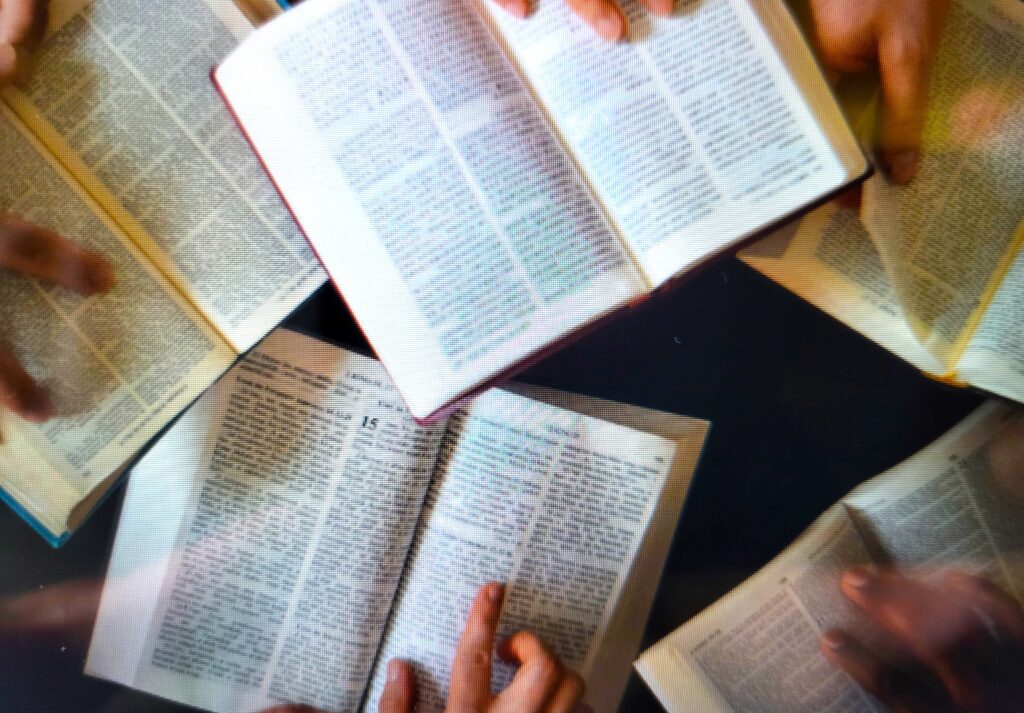
This Sunday’s readings may help explain why there are more than 450 English translations of the Bible. Linguists offer courses on the English words we put into the mouths of the prophets, the saints and even Jesus himself. Ours has been called a mongrel language owing to all the other languages that helped create it.
Take the words complain and complacency, for example. They are two sides of the same low-value coin we mortals spend so recklessly. We complain when we’re not satisfied, and we’re complacent when we’re too satisfied. This is a coin that funds our admission into a self-made hell, as the rich man in Christ’s parable from Luke’s gospel learns this Sunday (Luke 16:19-31).
At first his complacency makes him blind to the needs of others like poor Lazarus, who lay suffering and starving every day at this man’s door while he dined sumptuously. Then both of them die and the dinner tables are turned. Lazarus is suddenly in God’s kingdom enjoying the company of Abraham, while this formerly rich man turns complacency into complaining.
“Father Abraham, have pity on me,” he says. “Send Lazarus to dip the tip of his finger in water and cool my tongue, for I am suffering torment in these flames.”
This account implies there’s life after death, but that it’s either a life of bliss or suffering.
If the rich man had been more empathetic and had internalized the words of the prophets, he might have joined Lazarus in the afterlife, keeping company with the prophets, Jesus’ parable seems to say.
Sunday’s second reading invites us to ponder the differences between words like UNTIL and UNTO, which are used interchangeably in various versions of Paul’s first letter to Timothy (1 Timothy 6:11-16).
In the version we’ll read at Mass, Paul advises Timothy to compete well for the faith and to keep the commandments without stain or reproach—UNTIL the appearance of our Lord Jesus Christ … who alone has immortality.
So what happens after Christ appears? UNTIL implies an end point, and we’re told only Christ is immortal. But we’ve been taught to live for a life without end, whose only source is Jesus–the one whose very nature is eternal. Maybe that’s why the translators of the King James Bible interpreted Paul’s letter to read: “That thou keep this commandment without spot, unrebukable, UNTO the appearing of our Lord Jesus Christ.”
Linguists will tell you UNTO adds a purpose and direction that UNTIL doesn’t—a movement toward something bigger and beyond ourselves.
That something sounds like God’s Kingdom. But complacency is an eternal roadblock to that state of being, as the prophet Amos tells us in Sunday’s first reading (Amos 6:1a, 4-7). He might even have been one of the prophets the complacent rich man and his brothers in Christ’s parable avoided hearing while they were alive. That rich man’s death is tantamount to the permanent dead end sign UNTIL implies—set up in front of the narrow gate of God’s Kingdom. He might have changed his ways if he’d have heard Amos tell him:
Woe to the complacent in Zion! Lying upon beds of ivory, stretched comfortably on their couches, they eat lambs taken from the flock, and calves from the stall! … yet they are not made ill by the collapse of Joseph! Therefore, now they shall be the first to go into exile, and their wanton revelry shall be done away with.
“Done away with” means something or someone is finite. We in the 21st Century have a choice between accepting the permanent deadline of UNTIL or the linguistic lifeline that UNTO lets us follow toward communion with our infinite God.
–Tom Andel
Upon reading your thoughtful words, I feel a sense of urgency to do God’s Will
Ron, your dedication to sharing Faith and Light IS God’s will.
Wonderfully written Tom and, I believe, applicable to all. How we balance out life’s highs and lows WHILE keeping our hearts fixed on God and Jesus can be a great challenge. I’m thankful for the faith that we share which gives us so many “tools” to help re-calibrate our lives (including your writings!) Thank you!
Thanks as always, Mike. As someone who distributes his time and talent among many worthy causes, you know how important it is to find respite amidst this world’s demands. Ultimately, only ONE demand matters, and we must attend to it–as Martha learned.
Complacency is one of the greatest obstacles in our First World comfortable life. We have pretty much everything at our fingertips. Need something? Amazon Prime is just a few clicks away to get what you want. Sometimes the same day.
With all the comfort and convenience, Amos was right to give us a jolt of reality, and the parable of Lazarus and the rich man describes how our lifestyles can numb our senses to the big picture we are part of.
We need to continually remind ourselves that less is more.
Less is more!
Except where contemplation is concerned. In our hectic lives, more is never enough.