
(For the audio version of this blog, please visit: https://brothersinchristcmf.org/wp-content/uploads/2025/11/Mass-Blog-for-the-Second-Sunday-of-Advent-2025.mp3)
“The Sound of Music” was re-released in theaters this year, 60 years after its debut, enabling new audiences to experience this classic Rodgers & Hammerstein musical on the big screen. An unintended benefit might be that people noticed a buried treasure that was hidden from previous audiences cheated by the smallness of their TV screen—just as God’s truths are sometimes hidden by the smallness of our personal perspective.
One of the truths buried in that musical is the deep philosophy of our faith, expressed in the song Julie Andrews’ character Maria sings to Captain von Trapp, acknowledging her love for him:
“Nothing comes from nothing; nothing ever could, for somewhere in my wicked childhood, I must have done something good.”
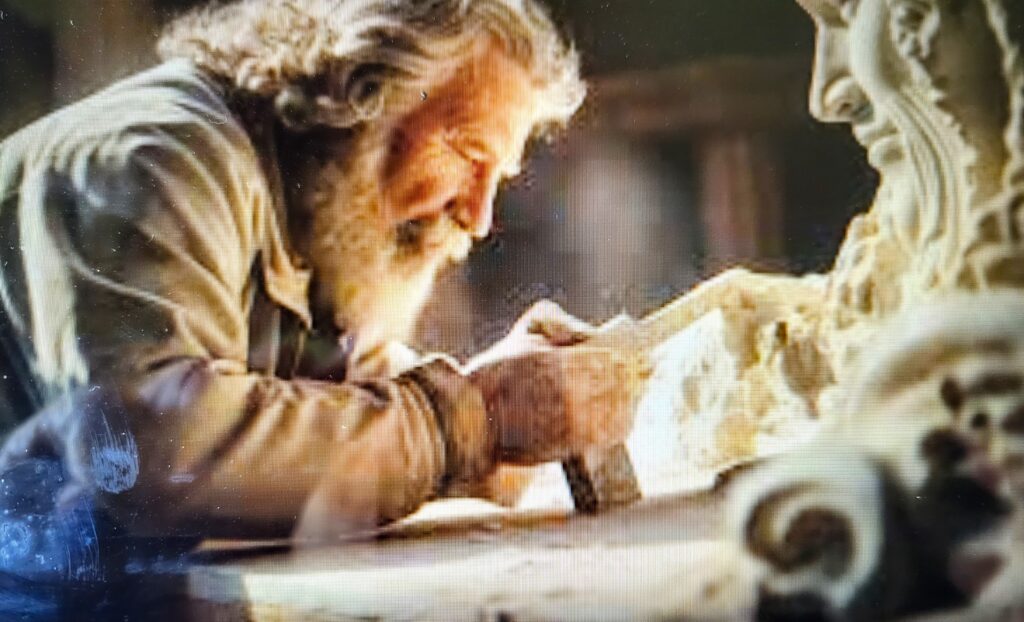
A life is a complex amalgam of raw materials that we spend sculpting into something good, like Michelangelo did with his art. In explaining how he was able to create one of his most beautiful sculptures, he said:
“I saw the angel in the marble and carved until I set him free.”
That creative process is celebrated in the season of Advent, especially in this second week’s liturgy, where the readings offer us inspiration about the sculpting process.
Isaiah foresaw the sculpting of Jesus from the stump of Jesse, King David’s father and the human bloodline from which came “something good.” In Sunday’s first reading (Isaiah 11:1-10) it is said the spirit of the Lord shall rest upon him, and as a result of his work, the wicked and the predators of the earth will be eliminated, and then….
There shall be no harm or ruin on all my holy mountain; for the earth shall be filled with knowledge of the LORD.
Divine knowledge is embedded in the world God created, and God gave us the desire to see it and set it free, just as Michelangelo saw and freed the angel imprisoned in a block of marble. We spend our lives setting God’s goodness free from the raw materials of our lives, enabling us to share knowledge of our Creator with each other.
That Divine creativity is a shared instinct. The faithful use their scripture-based knowledge of truth in sculpting their lives, setting God’s beauty free through the trial and error of living, as Paul tells us:
Whatever was written previously was written for our instruction, that by endurance and by the encouragement of the Scriptures we might have hope. (Romans 15:4-9).
Hope is the good fruit we produce through artful living. Jesus called it pruning, Michelangelo called it sculpting, but both are processes of producing something good out of the world’s wickedness. For John the Baptist, it was the process of separating wheat from chaff. (Matthew 3:1-12)
The one who is coming after me is mightier than I. … He will baptize you with the Holy Spirit and fire. … He will clear his threshing floor and gather his wheat into his barn, but the chaff he will burn with unquenchable fire.”
This Advent, let’s see if we can use our faith’s fire to creatively burn away the wickedness concealing that “something good” within ourselves.
–Tom Andel
What a beautiful reflection. It’s so true that God plants something good within us, but it takes time, faith, and perseverance to uncover it. Your reminder that we are not merely surviving life but actively sculpting it with Scripture as our chisel and heaven as our vision is brilliant. May we each continue allowing God’s grace to reveal the beauty He placed in us from the start. Thank you for this inspiring message especially as we begin our journey through Advent.
Thank you, Mike. Nothing allows us to reveal the beauty God placed in us more effectively than parenthood. You and Rachel are among the most talented sculptors I know.
Tom, your reflection made me think about volunteering. Maria’s lyric—“Nothing comes from nothing; nothing ever could”—reminds us that goodness doesn’t appear by accident. It grows from choices we once made to let grace shape us. Volunteering works the same way. People often think service drains their time, talent, or their wallet, but in truth, it is the tool that opens the wallet of the heart and reveals a reward that was there all along. When we give, we don’t lose—we uncover the “something good” God planted within us.
Like Michelangelo freeing the angel from the marble, service chips away whatever hides God’s beauty in us. Isaiah saw this in the stump of Jesse; Paul saw it in scripture that forms us; John the Baptist saw it in the fire that burns away chaff. All point to the same truth: grace shapes us when we let it.
This Advent, let’s volunteer not only to help others but to let God sculpt us. In giving, we discover the goodness already embedded in our lives—waiting to be set free.
George, you comment made me realize how many of our relatives are veterans, and how they shaped our country’s respect for service. There’s an affinity between The Knights and veterans. Many Knights across the country ARE veterans, and/or volunteer at VA medical centers. But volunteering can be as simple as delivering Meals on Wheels to our neighbors. Being a Knight of Columbus is a volunteering opportunity. The Knights invariably help each other by modeling various facets of Christ’s behavior. We make each other better. But that’s not unique to the Knights. It’s only human. God made us to be each other’s raw material.
Whether pruning, molding, sculpting or shaping, we are all indeed clay in the potter’s hands. With the coming of Christ for our redemption and salvation, the promise was given and is yet to be fulfilled.
But what is our part to play in this drama? We are called to have a child like faith in the promise we have been given. Through our baptism and active participation in the Sacraments of the church he founded, we have the journey laid out for us with clear guidance to our destiny.
With hope in his coming and faith in his promise we are assured of our eternal gift.
Happy Advent!
Part of having a childlike faith is to ask questions, just as a child would. In Matthew’s gospel, Jesus tells us:
“Ask and it will be given to you; seek and you will find; knock and the door will be opened to you. For everyone who asks, receives; and the one who seeks, finds; and to the one who knocks, the door will be opened.” (Matthew 7:7). Then later he tells us who is greatest in God’s Kingdom: “Amen, I say to you, unless you turn and become like children, you will not enter the kingdom of heaven. Whoever humbles himself like this child is the greatest in the kingdom of heaven.” (Matthew 18:3) A humble heart is one that seeks guidance, both through prayer and worship. Christ’s light shines through the Advent journey. Our faith is shaped along the way. As you suggest, that’s the part we play.
This comment comes from Brother Knight of Columbus Jason Shell, fellow member of Lafayette Council 3970:
I was reflecting on the idea of sculpting something with intricate detail, such as the angel Michelangelo saw in the block of marble. I am sure that was a mundane and lengthy process with unexpected challenges he occasionally met with a certain lack of clarity of the end result. Living our Catholic faith well is hard work; and while God is walking with us and guiding us, He is most likely going to “play the long game” as he leads us to where he wants us. Perhaps we should also allow God to guide us on our journey through scripture.
I suspect that while Isaiah succeeded in proclaiming the truth about the Messiah, this and the other prophets probably did not always have a clear understanding of what they were talking about. How can you describe in mere words, the indescribable reality of heaven? This makes me think of the words of Thomas à Kempis who wrote, “If you wish to derive profit from your reading of Scripture, do it with humility, simplicity, and faith. Eagerly ask yourself questions and listen in silence to the words of the saints, and do not let the riddles of the ancients baffle you. They were written down for a purpose.” (“The Imitation of Christ,” Book 1 Chapter 5 Verse 2).
This is my reply to Jason:
Jason, I can relate to your idea about letting God guide you through the Scriptures. I’ve gotten into the habit of using a random number generator to pick a page number in my Bible for me. I’ve often found that this leads me to places I didn’t realize I needed to go. I also realize that with God in our lives, nothing is random.