
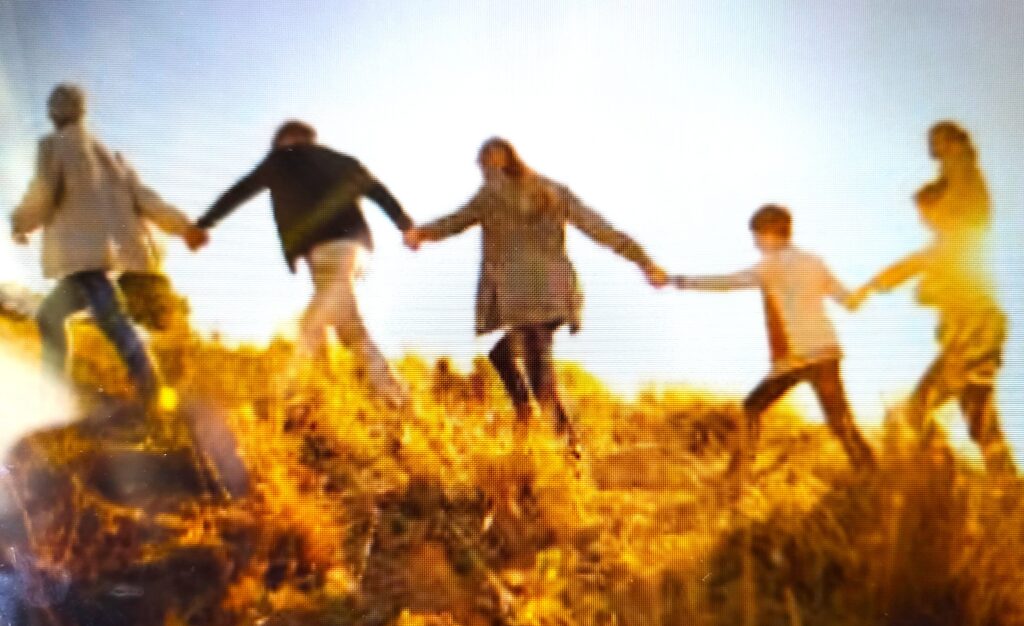
(For the audio version of this blog, please visit: https://brothersinchristcmf.org/wp-content/uploads/2025/12/Mass-Blog-for-the-Feast-of-the-Holy-Family-2025.mp3)
The Book of Sirach (Sirach 3:2-6, 12-14) offers a good set of instructions for maintaining a holy and whole family:
Honoring your father helps save you from your sins and makes your prayers more audible to God. It also brings your mother comfort, as does your reverence for her. These are non-verbal ways to atone for sins and store up spiritual wealth.
Unfortunately, Sirach’s was not among the Hebrew Scriptures Jesus, Mary and Joseph would have studied. They developed a set of guidelines for building a Holy Family by how they built their own, as reflected in the gospels—including Sunday’s reading (Mt 2:13-15, 19-23). It wasn’t easy. Joseph relied on divine reassurance that it was God’s Holy Spirit who impregnated his betrothed. Shortly after Jesus’ birth, Mary was told that her son would cause the rise and fall of many in power—and that his own rise to power wouldn’t come until his suffering and death pierced her heart with grief.
But what did Jesus contribute to the early construction phases of this Holy Family? Scripture tells us this child had many enemies, requiring Joseph to take actions ensuring his family wasn’t an easy target. We also learn that Mary must have worried about this, as when, after a torturous search for their missing boy, they found him discussing matters of faith among adults in the temple. “How could you do this to us?” she asked him.
His answer was delivered with an almost autistic indifference:
“Did you not know that I must be in my Father’s house?”
We are told that from then on, Jesus obeyed his parents and that Mary stored such memories in her heart—the one destined to be pierced.
Did young Jesus add more to her heart’s wear and tear? Scripture doesn’t tell us how the boy got along with other children—or even if he had friends. If he preferred hanging around with adults, we can imagine him being physically and emotionally bullied by children who couldn’t relate to that. Did he come crying to Joseph and Mary with those injuries or did he bottle them up? Did he carry such childhood baggage into adulthood as he embarked on his mission to save all of humanity—including his persecutors?
Mark’s gospel tells us that when Jesus’s family heard about how he was going about that mission they went out to “take charge of him, for they were saying, ‘He is out of his mind.'” We don’t know if Mary was among that “family,” but Mark does tell us of another instance where his mother and his brothers sent someone to tell him they were waiting for him. That inspired another autistic-like reply from Jesus:
“Who are my mother and [my] brothers?” Looking around at those seated with him in the circle he said, “Here are my mother and my brothers, for whoever does the will of God is my brother and sister and mother.”
Jesus, Mary and Joseph proved a Holy Family can be built despite its builders’ aches and pains. Or possibly because of them. Maybe that’s why Paul assumed those unpleasant human components come as part of our kit when he offered these tender reminders to anyone hoping to follow the J-M-J blueprint for building their own Holy Family:
“Wives, be subordinate to your husbands, as is proper in the Lord. Husbands, love your wives, and avoid any bitterness toward them. Children, obey your parents in everything, for this is pleasing to the Lord.” (Colossians 3:12-21 or 3:12-17)
These may not be politically correct instructions for this age’s Artificially Intelligent architects, but it was humanity’s perpetually imperfect politics that made Jesus’ salvific mission necessary from the start. With that in mind, families being subordinate to each other in today’s warring world seems like a pretty constructive plan.
–Tom Andel
The Holy Family teaches us that holiness is not forged in ideal conditions but in faithful obedience amid uncertainty, fear, and misunderstanding. Joseph acts without speaking, Mary trusts while storing sorrow in her heart, and Jesus learns obedience before revealing his mission. Family sanctity grows not from perfection, but from humble submission to God’s will, even when it wounds.
Yes, George, our faith teaches us that true obedience is an urge, not just an act. If just a robotic act in response to a command, we are no better than slaves. But as Paul teaches us in Galatians 4, Christ was born of a woman born under the law, to ransom those under the law so we may be adopted by his Abba. In that way, we are no longer slaves to this world, but heirs to God’s Kingdom. Our inheritance is a burning desire to live God’s love–which is as much a law requiring obedience as is the law that we must breathe in order to live.
The Holy Family shows that leadership at home isn’t about control or seeming perfect, but about faith amid uncertainty as pressures mount and resources (time, money, energy, confidence, faith) run thin. This is why it is so important to support and encourage parents in the early stages of their new reality.
For families in today’s culture, this feels especially relevant. Holiness is achieved by choosing love, sacrifice, and obedience to God’s will when the culture pulls us in every other direction. After all holy means to be set apart, distinct, consecrated. Are we living our lives to achieve this for God? Or do we try to fit in with the world? How our families form can be a strong measure of own holiness.
Agreed, Mike. Your point that leadership is more about faith than controlling is key, because if we try controlling everything we’re doomed to failure. That leaves our children more frightened than reassured. But if they see their parents pray, whether times are bad or good–better yet, are invited to pray with them–they’ve gotten their first lesson in effective leadership. Leaders always act from a position of strength. There’s strength in numbers.
The family is the central figure in any healthy culture or society. Diminish the family, and we negate the potential of the world we live in.
We are created for continuity especially in our homes, and if we do it right, we are the model for our children to attempt to emulate. If parents try to be good, faithful, holy, and virtuous, their kids usually follow the script.
Children born into single parent situations are at such a disadvantage. Pray God delivers more babies into solid loving homes. The future of this world depends on it.
Blessed Christmas and New Year to all!
Thomas, this is a timeless theme, especially as we celebrate the Holy Family of Jesus, Mary and Joseph. One Christmas movie that deserves more attention among the Frosties, Rudolphs and Grinches every year is “The Bells of St. Mary.” It involves the little girl of a single mother who sends her to live at the St. Mary orphanage. This Mom believed that without a father, she couldn’t give her child the life she deserved. The father is a musician who left them to win more successful gigs across the country. Of course, the movie has a happy ending, with the father being convinced to come home and see his daughter graduate from the orphanage school and reunite the family he started. Happy ending, miracle achieved. But miracles happen every day, behind our backs, not just at Christmas–and not just in movies. A friend of mine who mentored both of our sons and helped them achieve successful employment (and self-respect) was almost aborted while in his mother’s womb. His father felt they were not ready to have a baby. But the mother persisted and because she did, she changed not only their own lives, but the lives of our sons and countless other children with special needs who found purpose in life thanks to his parents discovering my friend’s purposeful life. All families serve a purpose, and that is to bring joy (and hope and love) to the world! Ours may not always be a happy life, but families make it a wonderful life.
It’s a Wonderful Life, released in 1946, is now a Christmas classic, in part because the copyright inadvertently lapsed in 1974. While many may consider it an overly sentimental film, it does have many “hidden gems”. For example, near the end of the film when George Bailey is exuberantly running through the snowy streets of Bedford Falls, he passes by the local movie theater. On the marquee you can see the title of a film showing there: The Bells of St. Mary’s (released in 1945). A movie I have not seen. I didn’t realize that it also had relevant themes at this time of the year. May we all be mindful not to overlook the inner beauty the Lord has placed within each of us.
That’s a discovery George Bailey…and Ebenezer Scrooge AND The Grinch … learned before it was too late. It’s written on the marquee of our hearts, inviting people in to appreciate where God’s direction can lead.
Like the many reflections. (Deacon Vince)
Thank you, Deacon Vince. I’m grateful for the many reflections that come back in this space as a result of our weekly posts. Thank God, I’m getting as good as I give. Dialog is a gift of the Holy Spirit.
Tom, your reflection helps all families use the example of the Holy Family as a model for family life.
Thanks Ron. ALL families demonstrate their holiness to the world by facing the challenges it throws at them while remaining faithful to the only reason for being.
I love you Tom Andel!
Chris, as fellow Faith & Light participants, ALL of us Andels love you and the sacred music you share with others. Merry Christmas!