
(For the audio version of this blog, please visit: https://brothersinchristcmf.org/wp-content/uploads/2026/02/Mass-Blog-for-the-2nd-Sunday-of-Lent-2026.mp3)
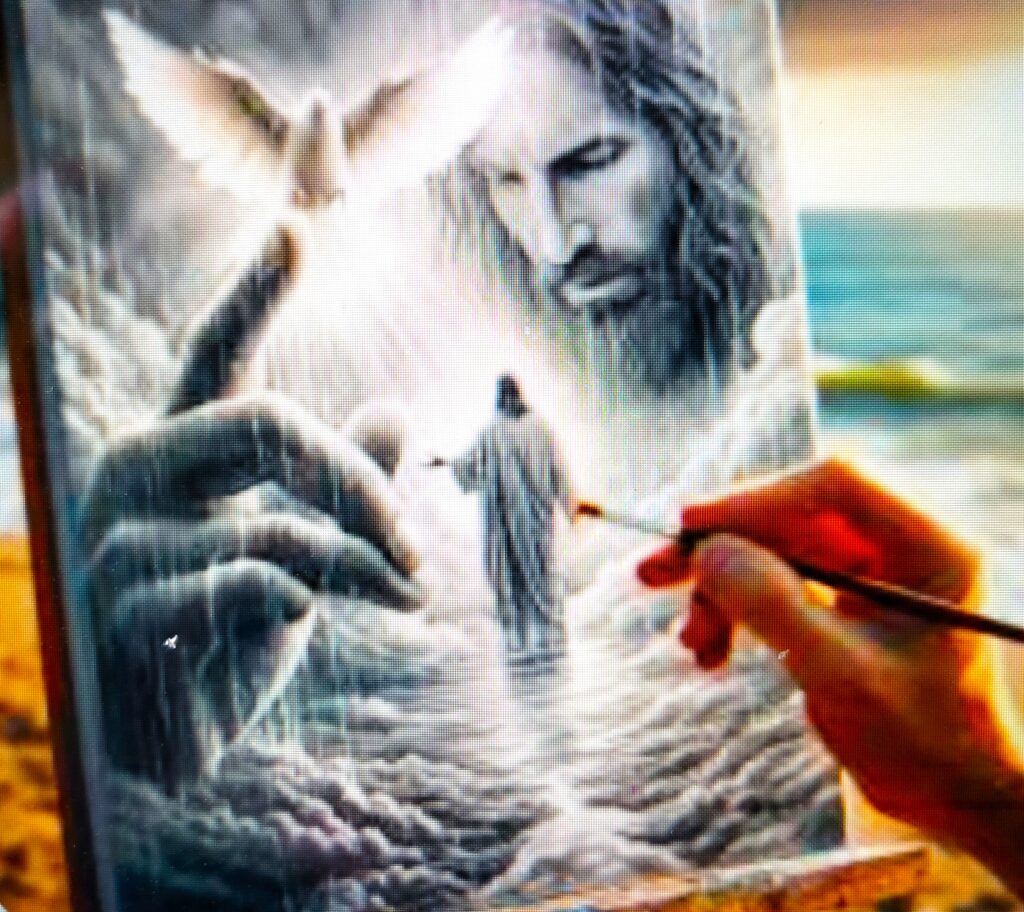
This Sunday’s readings look forward to the promise of Jesus, just as the entire season of Lent does. The appearance of Moses and Elijah alongside Jesus during his transfiguration in Sunday’s gospel reading tells us that he is the fulfillment of everything those two represent: The Law and The Prophets (Matthew 17:1-9). In this phenomenon Peter, James and John witnessed, the past and the future meet the eternal present in Jesus: God with us. Emmanuel. The Great “I Am” in human form.
Although John did not include in his own gospel the transfiguration he witnessed, he testifies to what the promise of Jesus meant to Abraham, our earthly father in faith. John does this by telling us what Jesus told the Pharisees:
“Abraham your father rejoiced to see my day; he saw it and was glad.” So they said to him, “You are not yet fifty years old and you have seen Abraham?” Jesus said to them, “Amen, amen, I say to you, before Abraham came to be, I AM.” (John 8:56-58).
For saying this they were ready to stone Jesus, but as we see in Sunday’s first reading, God promised that from Abraham would come a great nation (Genesis 12:1-4a). Later in Genesis, He promises that Sarah would give Abraham a son, Isaac, through whom God would maintain an everlasting covenant that would continue forever. (Genesis 17:19)
Of course, we know that God would later tell Abraham to sacrifice this son, just as God would sacrifice His own son to fulfill that covenant with humanity.
THAT son, the human “I AM” who is one with God in Spirit, would teach us the Lord’s Prayer, which tells us God’s Kingdom has come and His will would be done on earth as it is in heaven. The living word of God done on earth is Emmanuel: God alive with us as we live the Gospels.
Jesus said that whoever belongs to God hears the words of God. That is the transfiguration in John’s gospel. It is OUR transfiguration, which has always been part of God’s plan, as Paul tells Timothy in Sunday’s second reading (2 Timothy 1:8b-10):
The grace bestowed on us in Christ Jesus before time began, [is] now made manifest through the appearance of our savior Christ Jesus, who destroyed death and brought life and immortality to light through the gospel.
By believing and living the Gospel, we fulfill our own transfiguration as promised in the Lord’s Prayer. That kingdom will come as his will is done on earth as it is in heaven.
Are you transfigured? Say “I am!”
–Tom Andel
We in the 21st century need to be reminded that “I AM” is not just a poetic phrase — it is the revealed name of God. This divine name expresses God’s eternal, self-existent being — the One who simply IS: not bound by time, not created, not becoming, but pure, eternal presence.
At the Transfiguration, the meaning of “I AM” becomes visible and profound: Jesus is not merely a prophet pointing to God. He is God with us — Emmanuel — the eternal “I AM” revealed in glory, not changed into God, but shown to be who He always was.
We’d be better served–and we’d serve God better–by turning our “I AM” into “I DO,” like the vow of someone getting married or someone entering a service. We as Christians are like Christ’s disciples given our marching orders. In John’s gospel (John 14:12) Jesus says, “whoever believes in me will do the works that I do, and greater because I AM going to the Father. Whatever you ask in my name, I will do.” He is virtually asking, “Do you believe?” and “Will you do my work?” We should answer, “I AM committed to fulfilling my “I DO” with “I WILL.”
Knowing God’s will for us and “doing it” is one of the great mysteries of our faith. How do we know what his will for us is?
I suppose following his instructions through his word as proclaimed in the Gospels is a good start, but only a starting point. As stated in the reading from Saint Paul to Timothy we will have to bear hardships for following Jesus and that’s where our journey gets complicated. How do we do this without wavering or giving up? We do it with the strength that come from God, as Saint Paul states.
How do we develop this strength?
By having faith in Jesus Christ knowing that He is the great I Am!
“I can do all things through Christ who strengthens me!”
Yes! And we know prayer is a primary source of strength. Jesus gave us The Lord’s Prayer for a reason. It states, “Thy Kingdom come, Thy will be done.” Our Father wants us to communicate with Him. From that communication we must believe God talks back. If we’ve fallen away from that habit, Lent is a good time to re-establish that line of communication. That alone–praying The Lord’s Prayer–is doing Our Father’s will. Like the Gospels, SOMETIMES it’s done with words.
Tom, your sentence “Like the Gospels, SOMETIMES it’s done with words” reminded me that sometimes doing God’s will is expressed in words—through prayer, preaching, or confession of faith—and other times it’s expressed in action—through forgiveness, sacrifice, obedience, and endurance. So our faith isn’t just spoken; it’s lived.
Unfortunately, George, in this warring world, SOMETIMES feels like few-and-far-between times. I remember an old pop standard called “This is Always,” sung by guys like Nat King Cole. Its opening could be adapted as a hymn: “This isn’t sometimes, this is always. This isn’t maybe, this is always. This is love, the real beginning of forever.” Love is God’s will. It is ALWAYS.