
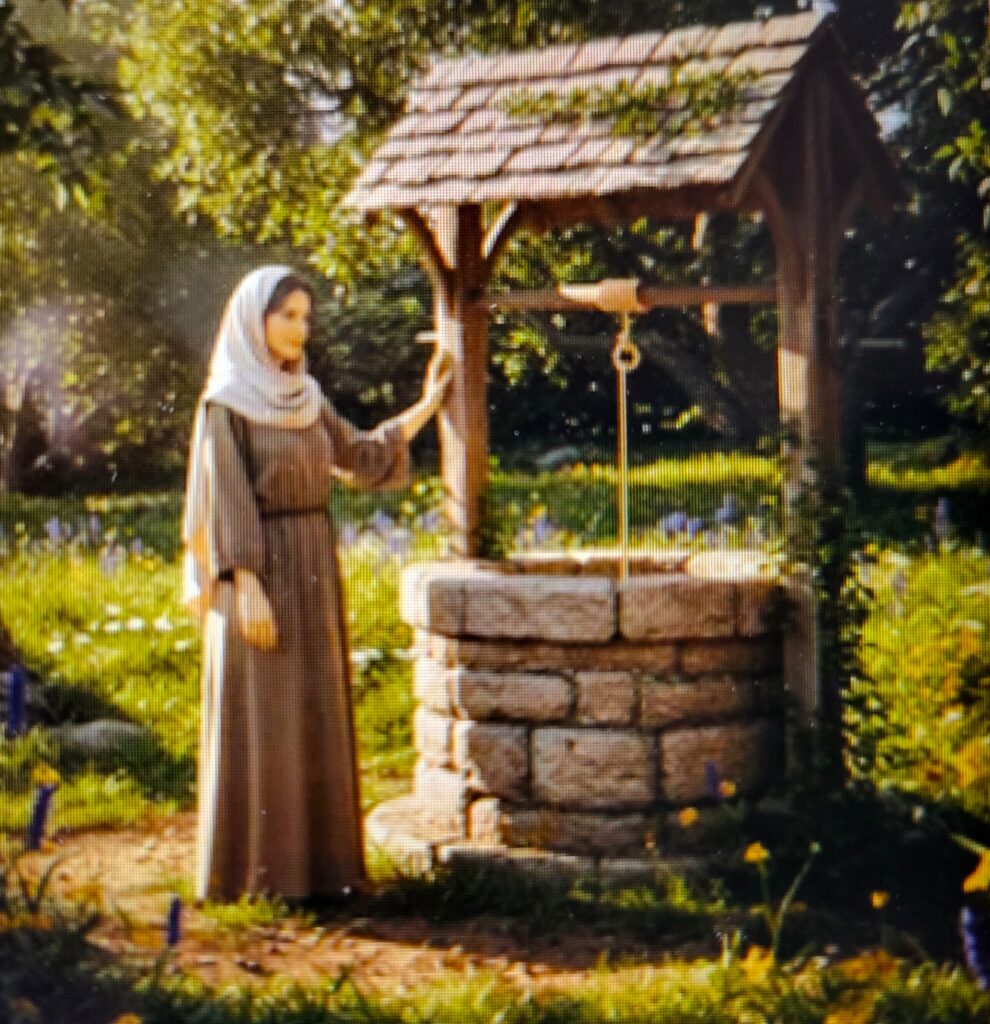
(For the audio version of this blog, please visit: https://brothersinchristcmf.org/wp-content/uploads/2026/02/Mass-Blog-for-the-3rd-Sunday-of-Lent-2026.mp3)
Jesus said to them, “My food is to do the will of the one who sent me and to finish his work.”
That’s what Jesus tells his disciples in this Sunday’s gospel reading (John 4:5-42), but as we go through the liturgies of Lent, we are reminded that Jesus must have been constantly hungry and thirsty during his ministry. His work would only end on the cross, when he declared, “It is finished.”
Just before he said that, from the same cross, he said “I thirst.”
While waiting for the solemn Good Friday on which we’ll read that piece of scripture, this Sunday we focus on our thirst as represented by the Samaritan woman in the same gospel passage with which we led this meditation. Jesus asks her for a drink she’s not prepared to offer, so he offers the drink that WILL prepare her, and us, to be quenched:
“Whoever drinks the water I shall give will never thirst; the water I shall give will become in him a spring of water welling up to eternal life.”
Two-thousand years after his crucifixion, Jesus continues to offer us living water—yet we prefer to seek fulfillment from an endless assortment of this world’s dry wells. Even in the Old Testament, humanity is shown to be constantly unfulfilled. How many times in the Bible do his chosen people grumble against God about their discomfort? In the Book of Numbers God tells Moses:
“The people who have seen my glory and the signs I did in Egypt and in the wilderness … nevertheless have put me to the test ten times already and have not obeyed me.” (Numbers 14:22)
Did the work Christ finished from his cross satisfy our hunger and thirst, or are we still complaining as the Israelites did during their desert exodus?
We’ve been taught that God is love, but today’s readings make us ponder, could God’s love be an eternal process of thirst-and-quench? In God’s plan, with our participation, these processes go together so we can be in a constant state of satisfaction with God. But as those thirsty Israelites in this Sunday’s first reading demonstrate, we tend to be all thirst and no quench. (Exodus 17:3-7)
Why does God continue to offer us chance after chance to quench his thirst for our love, as he did in those Old Testament instances He enumerated for Moses? We share a thirst with God, but unlike God, we’re stingy with our quenching love. We tend to hoard it, dispensing it only to those who offer their short supply of living water to us. That’s not living water, it’s the stagnant kind that dries up quickly.
The thirst-and-quench cycle can only be sustained by the living water of the stream running through God’s Kingdom. We have the power to quench God’s thirst for our love by sharing it with fellow thirsting souls. That’s how God’s Kingdom comes on earth as it is in heaven.
As Paul tells us this Sunday, the love of God is poured into our hearts through the Holy Spirit who has been given to us. We share it with God by sharing it with ALL souls—as Jesus did. Paul reminds us, his living water was even offered for the ungodly.
“Indeed, only with difficulty does one die for a just person, though perhaps for a good person one might even find courage to die. But God proves his love for us in that while we were still sinners Christ died for us.” (Romans 5:1-2, 5-8)
But he also rose, like water in an active well. Living water is always running, but never runs out.
–Tom Andel
Christ created in us a hunger and thirst for him. It’s an intuitive yearning propelled through our baptism in the Lord and in his church.
He knows nothing earthly can satisfy our need to be unified with him, though try as we might, we remain unsatisfied.
Longing to be in union with Jesus is the gift he shares with everyone. There is nothing on our journey of life that matters more than to be one with Christ.
Through Him, with Him, In Him, in unity with the Holy Spirit! Says it all.
Yes, we hear that concluding doxology at every Mass, as bread and wine become His body and blood. The unity of the Holy Spirit is where we come in, to act as evangelists to spread that thirst and the faith that quenches it at the same time. At the Mass’s conclusion, we are exhorted, “Go in peace.” We are being sent into a thirsty world.
The “hangry-ness” (new word?) of the world is an interesting idea to digest. We are all hungering for the same thing but don’t even realize it. Instead the world feasts on the lustful romance of “Twilight”, which ironically focuses on vampires who thirst for blood or zombies that dine on flesh, neither of which satisfies and leaves the soul unfulfilled rather than going to the true source, Jesus. If this fascination was just aimed towards the truth, rather fiction, what a different place our world would be…
Mike, sometimes it seems our culture is populated by vampires and zombies. What they live for leads to dead ends. The flesh and blood they eat and drink is always at someone else’s expense. Death is mutually assured. The flesh and blood we Christ hungerers eat and drink leads us to new life and shared being with the One who has always been.
Water in Scripture is never incidental; it is revelatory.
God thirsts for communion with each soul as deeply as we thirst for meaning. On the cross, when Christ declares, “It is finished,” his saving work is complete — yet grace keeps flowing. From his pierced side come blood and water, signs that grace is not static but living and active.
Stagnant water evaporates; living water circulates. To drink of Christ is to become a conduit, not a reservoir. A full well cannot help but overflow. In that overflow — love poured freely without measure — both our thirst and God’s are quenched.
George, it’s fun to think about Jesus’ insatiable thirst for wisdom as a boy (both imbibing and dispensing it). That’s illustrated in scripture and in the rosary’s Joyful mystery when his parents find the child they thought they’d lost sitting in the Temple (going about his Father’s business). Who knows, maybe Sirach, one of the Bible’s Wisdom books, might even have contributed to his teachings about life-giving water. Sirach 18:28-29 says, “Every wise person teaches wisdom, and those who know her declare her praise. Those skilled in words become wise themselves, pouring forth apt proverbs like life-giving waters.” Later in John’s gospel, after his encounter with the woman at the well, Jesus says, “Let anyone who thirsts come to me and drink. Whoever believes in me, as scripture says: ‘Rivers of living water will flow from within him.” (John 7:37-38).
If Jesus allowed us to feel completely satisfied every time we encountered him, say through the Eucharist, we would either stop seeking a relationship with him because we would be happy having had our needs met or we would see the Eucharist as a fix that we could use as means to comfort our uneasiness rather than receiving the Eucharist out of our desire to remain in close relationship with Him.
You’re right, of course, Jason. The thirst/quench relationship is based on love, and there can’t be love without a desire for the good of another. That’s the only path to complete satisfaction.