
(For the audio version of this blog, please visit: https://brothersinchristcmf.org/wp-content/uploads/2026/06/Mass-Blog-for-the-12th-Sunday-in-Ordinary-Time-2026.mp3)
Bullying has become an art on social media. It takes many forms, from the disguised insults of “frenemies” to the open mockery of cyber harassers. But this is an ancient art form, as we see in this Sunday’s readings. The prophet Jeremiah suffered so much from persecution and rejection in his 40-year ministry that the mockery continued even after his death when readers of his words called him “the weeping prophet.” Try hearing Jeremiah’s voice this Sunday as we read his words:
“I hear the whisperings of many: ‘Terror on every side! Denounce! Let us denounce him!’ All those who were my friends are on the watch for any misstep of mine. ‘Perhaps he will be trapped; then we can prevail, and take our vengeance on him.’” (Jeremiah 20:10-13)
Like all victims of bullying, Jeremiah longed for revenge, as a few lines later he prays,
“O LORD of hosts, you who test the just, who probe mind and heart, let me witness the vengeance you take on them.”
The God we worship knows every form of our mockery, as He has been its target since Satan turned Adam and Eve against Him in the Garden of Eden. How can the created mock the Creator?
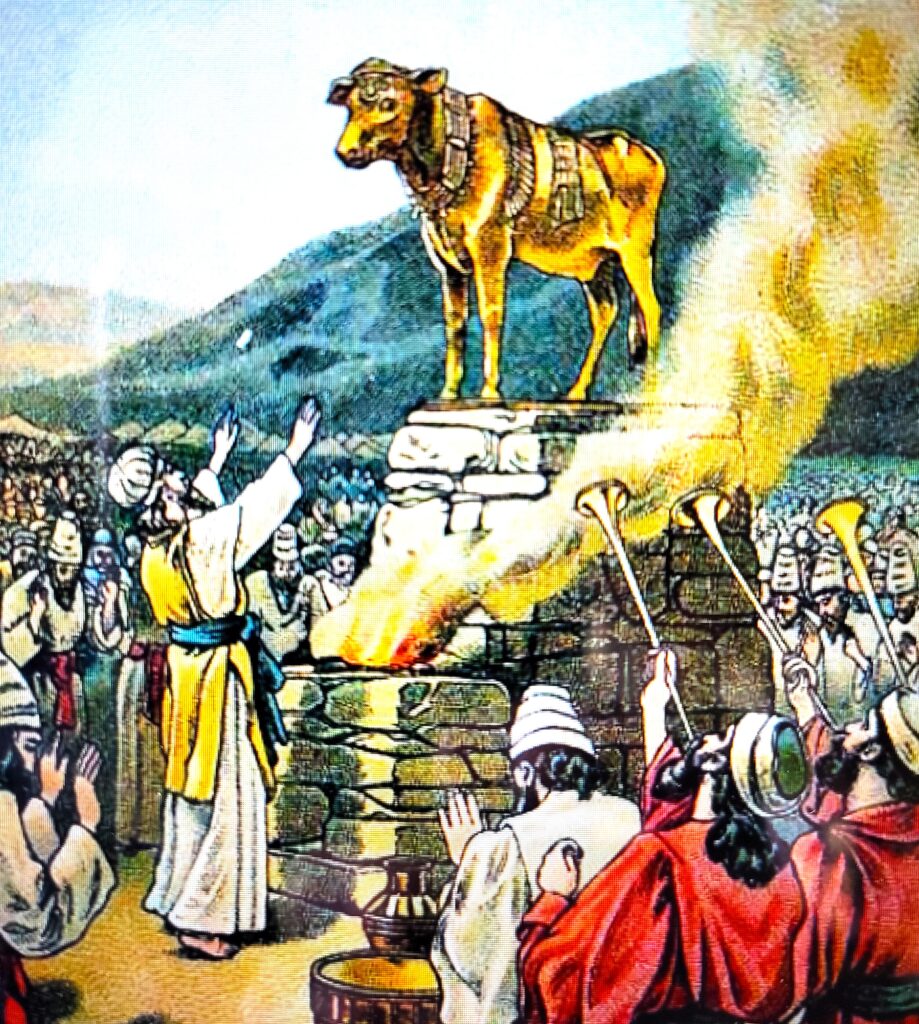
We do so with the false gods we choose to displace Him. There are many, all of whom cater to our base desires rather than giving us the love we need to resemble the God who made us in His image. We mock God when we try to imitate God’s power rather than His mercy. We then quickly turn that unholy spirit of bullying against the other souls God puts in our lives to make us holy. Instead of trying to make others better, we try to make them worse—which only worsens us by further distancing us from the one and only true God.
Bullies and their victims hunger for revenge, but as Moses quotes God in Deuteronomy 32:35, “Vengeance is mine!” This is not a vengeance God needs to take on us, but a self-fulfilling prophecy of our own making, as Moses later quotes God as asking, “Where are their gods,the rock in whom they took refuge, who ate the fat of their sacrifices and drank the wine of their libations? Let them rise up now and help you! Let them be your protection!”
By denying the existence of the one real God, we turn our backs on God’s love and protection.
Jesus speaks to us like a consoling mother and a virile brother in Sunday’s gospel reading (Matthew 10:26-33) as he reunites us with reality, comforting us bullied souls with these reassuring words:
“Even all the hairs of your head are counted. So do not be afraid; you are worth more than many sparrows. Everyone who acknowledges me before others I will acknowledge before my heavenly Father. But whoever denies me before others, I will deny before my heavenly Father.”
Those who deny such comfort to others deny it to themselves. They repeat the original sin of Adam by embracing the false gods Satan used to bully him away from the One he was created to resemble. Such bullying only makes us resemble the bully. So God made Himself to look like us so we could reverse course and look more like Him in the form of Jesus the Christ.
Paul’s reminder to the Romans is a reminder to us that not only can’t God be bullied, neither does he need vengeance. Christ’s success is God’s most powerful revenge:
“If your enemy is hungry, feed him; if he is thirsty, give him something to drink; for by so doing you will heap burning coals upon his head,” Paul says in Romans 12:20-21. “Do not be conquered by evil but conquer evil with good.”
That good flows abundantly from Christ’s cross and into our hearts. And as Paul also tells the Romans in this Sunday’s second reading,
“The gift is not like the transgression. For if by the transgression of the one the many died, how much more did the grace of God and the gracious gift of the one man Jesus Christ overflow for the many.” (Romans 5:12-15)
The abundance of God’s eternal Kingdom has no room for our temporary world’s bullies.
–Tom Andel
One phrase that struck me was that God places other souls in our lives not merely as companions, challenges, or responsibilities, but as instruments of our sanctification. I had never really considered it quite that way, except perhaps in the case of the person I have spent the most time with—my wife. It is easy to view difficult people, critics, or even those who disappoint us as obstacles to overcome or avoid. Yet every person we encounter can be an opportunity to grow in patience, mercy, forgiveness, and love—virtues that help us become more like Christ. Seeing others as part of God’s plan to make ME holy gives my most challenging relationships a deeper purpose, meaning, and perhaps even motivation.
George, one might think a Christian is awfully egocentric to think God puts people in our lives to shape us spiritually. But your comment and two pieces of scripture support our way of thinking. You mentioned the effect marriage has had on you. Mark 10:9 tells us God had a hand in that “What therefore God has joined together, let not man separate.” What makes any one of us so important? David wondered that in his psalm 8:4: “What is man, that thou art mindful of him? and the son of man, that thou visitest him?” If we are filled with the Holy Spirit, we are filled with God. How can we NOT be influenced by God’s human engineering? We fascinate Him!
After nearly 28 years, I still recall my hometown parish priest’s words describing marriage as a covenant—relational, personal, and irrevocable—mirroring God’s own faithful covenant with humanity. In that light, I understood that this union would ask more of me than anything else in my life: not as an accomplishment like a diploma to be earned and set aside, but as a lifelong calling that would continually shape who I am and, after this week’s mediation, how I should respond in love to every soul I encounter.
Sometimes we overlook very powerful messages in the bible and wonder why we miss it or overlook it. This one jumped out at me when reading this excellent blog:
Everyone who acknowledges me before others I will acknowledge before my heavenly Father.
How often do we put this into practice and how powerful it would be on our journey. Jesus the Godman will acknowledge us before his heavenly father. Whoa!!
Reminds me of the two criminals crucified with our Lord. One acknowledged Jesus and appealed to him, the other the opposite. We know how that story ended.
God is good!
Thomas, it says a lot about our humanity the way the account of the thieves crucified with Jesus varies with each gospel writer’s perspective. Only Luke, the physician, mentions the good thief whose soul was healed by Jesus upon that thief’s both showing and requesting mercy–a moment of escape from our inhumanity for both of them.
Along those same lines, how often I view the people of the Bible as literally “holier than thou” but that first reading is a reminder, life is not easy for Gods people on Earth, we still have to contend with the same temptations and struggles. But still, Jeremiah walks the path that The Living God puts before him. We won’t always like it but that’s how our character and submission is tested and strengthened!
I was reminded this week of a quote “the best revenge is to live well”, and how much better can it get than Heaven? If that is our end goal, the Bible gives us a clear play book to it. I know sometimes I look elsewhere and forget my priorities.
Lastly, “We mock God when we try to imitate God’s power rather than His mercy.” WOW this hit me Tom!
Thank you so much for your messages!
The Bible has more sinners than saints, Mike. That makes it a great recipe book for what NOT to dish up for others. We’re just to serve up what God feeds us on a daily basis. Mercy.